
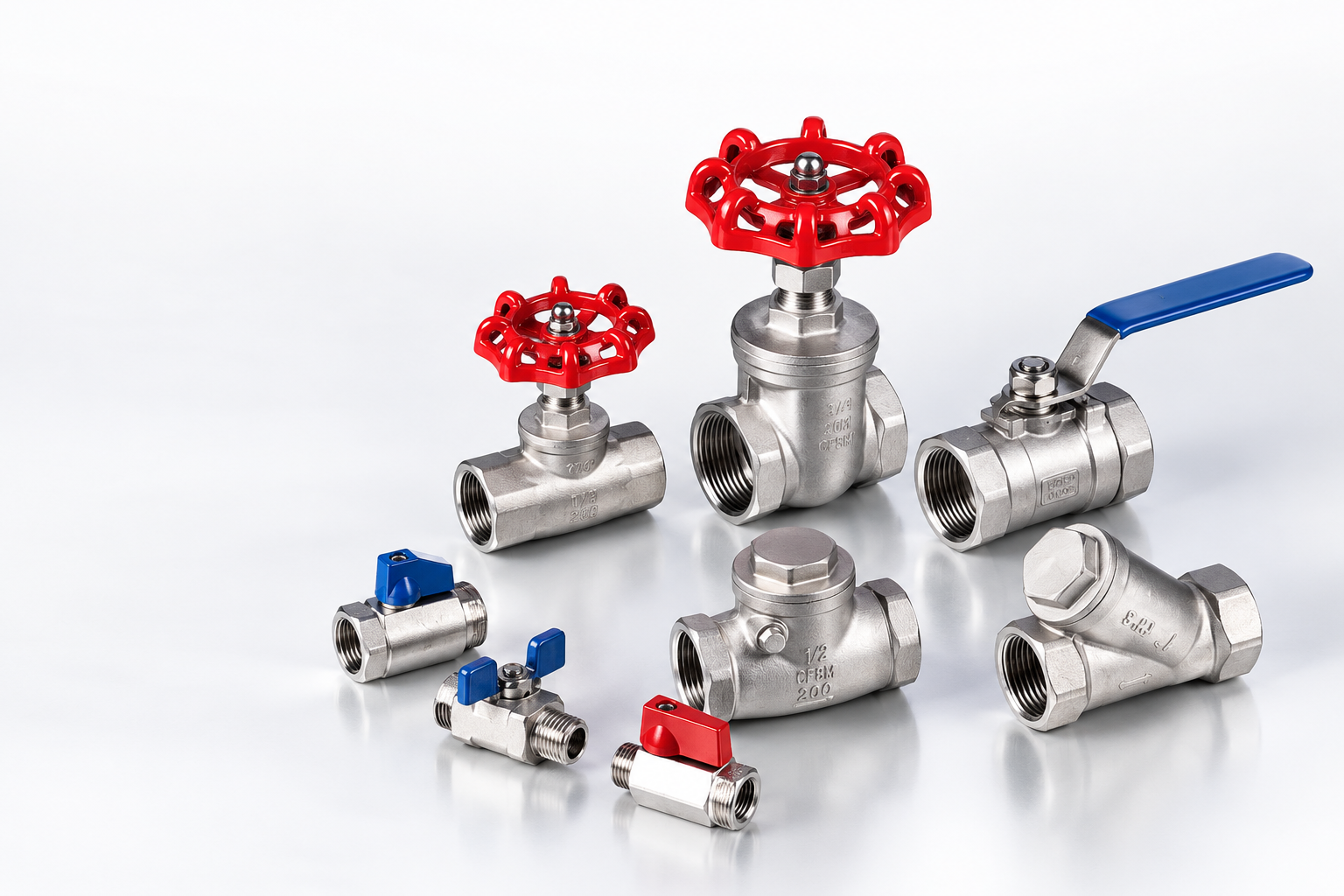
When sourcing stainless steel valves, one of the most common material questions is whether to choose 304 or 316 stainless steel.
Both grades are widely used for valves, fittings and fluid-control components, and both provide good corrosion resistance in many environments.
However, they are not interchangeable in every application. Differences in alloy composition can affect resistance to chlorides, localized corrosion, chemical exposure and, ultimately, the cost of the valve.
For buyers, the correct question is therefore not simply “Is 316 better than 304?” but rather: “Which material is appropriate for the actual fluid and operating environment?”
Quick answer: 304 stainless steel is commonly suitable for general-purpose water, plumbing and many industrial applications. 316 stainless steel contains molybdenum, which generally improves resistance to localized corrosion, especially in environments containing chlorides. For coastal, saline or more aggressive environments, 316 is often considered before 304, but the final material must still be checked against the actual fluid, concentration, temperature and operating conditions.
1. Why Does Stainless Steel Grade Matter in a Valve?
A valve is continuously exposed to the fluid flowing through it and may also be exposed to humidity, cleaning chemicals, outdoor air or corrosive deposits on its external surfaces.
The stainless steel grade can influence how well the valve body and internal metal components resist corrosion under those conditions.
Material selection can affect:
- Resistance to general corrosion
- Resistance to pitting and crevice corrosion
- Performance in chloride-containing environments
- Compatibility with the process fluid
- Suitability for cleaning and sanitation conditions
- Expected maintenance requirements
- Product cost
This is why the material grade should be confirmed during valve selection rather than treated as a cosmetic specification.
2. What Is 304 Stainless Steel?
Type 304 is one of the most widely used austenitic stainless steels.
It is primarily a chromium-nickel stainless steel and is commonly associated with the familiar “18-8” stainless steel family.
For valve applications, 304 is often considered for general water systems and other environments where the fluid is compatible and chloride exposure is not severe.
Typical Advantages of 304
Good general corrosion resistance, broad availability and a favorable balance between performance and material cost.
Main Selection Limitation
Its resistance to localized corrosion can become more important to evaluate when chlorides, salts or more aggressive chemicals are present.
3. What Is 316 Stainless Steel?
Type 316 is also an austenitic stainless steel, but it contains molybdenum in addition to chromium and nickel.
The molybdenum addition is one of the main reasons 316 generally performs better than 304 against localized corrosion in chloride-containing environments.
For this reason, 316 is frequently considered for applications involving coastal exposure, salt-containing water, more aggressive cleaning conditions or other environments where corrosion risk is higher.
Important: 316 stainless steel should not be described as “corrosion-proof.” Its suitability still depends on chloride concentration, temperature, fluid chemistry, deposits, crevices, flow conditions and valve design.
4. 304 vs 316 Stainless Steel Valves: Key Differences
| Comparison | 304 Stainless Steel | 316 Stainless Steel |
|---|---|---|
| Stainless steel family | Austenitic Cr-Ni stainless steel | Austenitic Cr-Ni-Mo stainless steel |
| Molybdenum | Not a standard alloying addition | Added to improve corrosion resistance |
| General corrosion resistance | Good in many common environments | Good to higher depending on environment |
| Chloride resistance | More limited | Generally better than 304 |
| Pitting / crevice corrosion resistance | Lower than 316 | Generally higher |
| Typical material cost | Usually lower | Usually higher |
| General water systems | Often suitable when conditions are compatible | Also suitable, but may be unnecessary in mild conditions |
| Salt / chloride exposure | Requires careful evaluation | Usually preferred over 304, but still requires verification |
5. Why Does Molybdenum Matter?
Stainless steel protects itself through a thin passive oxide film that forms on the surface.
In aggressive environments, especially those containing chloride ions, this passive film can locally break down. That can lead to corrosion mechanisms such as pitting or crevice corrosion.
The molybdenum present in 316 helps improve resistance to this localized attack.
This is one of the most important practical differences between 304 and 316 when selecting valves for environments containing salts or chlorides.
6. Is 316 Always Better Than 304?
From a corrosion-resistance perspective, 316 often provides an advantage in more aggressive environments.
But that does not automatically mean every valve should be specified in 316.
If a valve is operating in a relatively mild, compatible water environment, 304 may already provide the required performance.
Specifying 316 without evaluating the actual application can increase material cost without necessarily providing meaningful additional value.
Buyer principle: choose the material according to the operating environment, not simply according to the highest grade number available.
7. When Is 304 Stainless Steel Often Considered?
Subject to the specific valve design and operating conditions, 304 may be considered for applications such as:
- General clean-water systems
- Plumbing and building services
- Utility water lines
- General industrial piping
- Indoor installations with limited chloride exposure
- Applications where 304 is already specified by the project
Fluid chemistry, temperature and the complete valve specification should still be checked before confirming the material.
8. When Should Buyers Consider 316 Stainless Steel?
316 is commonly evaluated when the corrosion environment is more demanding.
Examples may include:
- Higher chloride exposure
- Coastal or salt-laden environments
- Certain process-water systems
- Applications involving more aggressive cleaning chemicals
- Projects specifically requiring 316 material
- Situations where improved localized corrosion resistance is needed
Do not use “marine grade” as the only selection rule. Continuous seawater exposure can be demanding even for 316. For severe marine or chemical conditions, a higher-alloy material may be required.
9. 304 vs 316 for Water Valves
The word “water” alone does not provide enough information to select the stainless steel grade.
Buyers should ask:
Drinking water, process water, cooling water and salt-containing water can create very different material requirements.
Chlorides are particularly important when evaluating localized corrosion risk.
Corrosion behavior can change as operating temperature changes.
Crevices and deposits can create localized conditions that are more aggressive than the bulk fluid.
10. Valve Body Material Is Not the Whole Specification
A common purchasing mistake is to confirm only the valve body material.
A stainless steel valve can contain several different metallic and non-metallic components.
Depending on the valve type, these may include:
- Valve body
- Bonnet or body cap
- Ball, disc or gate
- Stem
- Spring
- Fasteners
- Seat material
- Stem packing
- O-rings and other seals
Therefore, a product described simply as “316 stainless steel valve” should still be checked against a bill of materials or technical specification.
For RFQs: specify whether 316 is required only for the body or also for the stem, ball, disc, spring, fasteners and other wetted components.
11. What Do CF8 and CF8M Mean on Cast Stainless Steel Valves?
Buyers may notice that cast stainless steel valve bodies are not always marked simply as “304” or “316.”
Cast valve specifications commonly use casting-grade designations such as CF8 and CF8M.
These designations belong to casting specifications, so they should not be treated as nothing more than alternate marketing names for wrought 304 and 316.
When comparing quotations, confirm the exact material standard and grade required for the valve body.
Buyer tip: if one quotation says “SS304,” another says “CF8,” and a third only says “stainless steel,” ask each supplier to state the applicable material specification before comparing price.
12. What About 304L and 316L?
The letter L identifies a lower-carbon version of the corresponding stainless steel grade.
Lower-carbon grades are often considered where welding and resistance to intergranular corrosion in the heat-affected zone are important.
However, buyers should not automatically replace 304 with 304L or 316 with 316L without checking the drawing, material standard and manufacturing process.
13. Does 316 Allow Higher Pressure Than 304?
Not necessarily.
A valve's allowable pressure is not determined by the stainless steel grade alone.
Pressure capability also depends on:
- Valve design
- Wall thickness
- Body construction
- Nominal size
- Temperature
- Seat and sealing materials
- Applicable pressure class or product specification
A 316 valve should therefore not be assumed to have a higher pressure rating simply because the alloy has higher corrosion resistance in some environments.
14. Does 316 Allow a Higher Working Temperature?
Material grade is only one part of the temperature limit.
In many valves, the practical temperature range may be controlled by the seat, packing or seal material before the stainless steel body becomes the limiting factor.
PTFE, reinforced PTFE, elastomers and other sealing materials have different temperature and chemical compatibility ranges.
Always evaluate the complete valve assembly. Do not select a valve for a high-temperature application using the body material alone.
15. How Much More Does a 316 Stainless Steel Valve Cost?
There is no fixed percentage difference.
316 generally has a higher raw-material cost than 304 because of its alloy composition, including molybdenum. However, the final valve price is influenced by much more than the material grade.
Other cost factors include:
- Valve size and weight
- Casting or forging requirements
- Machining complexity
- Pressure rating
- Seat and seal materials
- Surface finish
- Testing requirements
- Order quantity
- Documentation requirements
- Packaging and OEM requirements
A technically equivalent quotation should therefore be compared by complete specification rather than by the words “304” or “316” alone.
16. How Can Buyers Verify the Stainless Steel Grade?
For projects where material grade is critical, the verification requirement should be agreed before the order is placed.
Depending on the project, buyers may request:
- Material specification on the quotation
- Valve drawing or bill of materials
- Material certificate when required
- Heat or batch identification where applicable
- PMI verification when specifically required
- Sample confirmation before bulk production
The required level of documentation should match the risk and technical requirements of the application.
Do not rely only on appearance. 304 and 316 stainless steels can look very similar, so visual inspection alone cannot reliably confirm the alloy grade.
17. 304 vs 316 Stainless Steel Valve Selection Table
| Application Condition | Material Direction to Evaluate |
|---|---|
| General indoor water service with mild conditions | 304 may be sufficient |
| Project specification explicitly requires 304 | Use the specified 304 grade |
| Higher chloride exposure | Evaluate 316 before 304 |
| Coastal or salt-laden atmosphere | 316 is generally preferred over 304 |
| Continuous seawater or highly aggressive conditions | Do not assume 316 is sufficient; perform material review |
| Chemical process application | Check chemical compatibility for the exact fluid and concentration |
| Welded construction with intergranular corrosion concerns | Evaluate 304L / 316L according to specification |
This table is a selection guide, not a substitute for project-specific corrosion or materials engineering.
18. What Information Should Be Included in an RFQ?
An RFQ that only says “316 stainless steel valve” leaves many technical questions unanswered.
A clearer request should include:
- Valve type
- Nominal size
- Required stainless steel grade
- Which components must use that grade
- Connection type and thread or flange standard
- Working pressure
- Working temperature
- Fluid or medium
- Chloride or chemical exposure when relevant
- Seat, seal and packing requirements
- Material documentation requirements
- Testing requirements
- Quantity by size
This makes quotations easier to compare and reduces the risk of receiving valves that look similar but have different material configurations.
Frequently Asked Questions
Is 316 stainless steel always better than 304?
316 generally provides better resistance to localized corrosion in chloride-containing environments, but it is not automatically the best economic or technical choice for every application.
Can 304 stainless steel valves be used for water?
304 is commonly used in many water applications, but suitability depends on water chemistry, chloride content, temperature and other operating conditions.
Is 316 stainless steel suitable for seawater?
316 generally performs better than 304 in chloride-containing environments, but continuous seawater exposure can still cause localized corrosion. Severe marine service may require a more corrosion-resistant alloy.
Does a 316 valve have a higher pressure rating than a 304 valve?
Not necessarily. Pressure rating depends on valve design, size, wall thickness, temperature, seats, seals and the applicable product specification.
What is the difference between 316 and 316L?
316L is a lower-carbon version of 316. Lower carbon content can be important where welding and resistance to intergranular corrosion are concerns.
Can I identify 304 and 316 by appearance?
No reliable material confirmation should be made from appearance alone. Where grade verification is important, appropriate material documentation or testing should be specified.
Should every component of a 316 valve be made from 316?
Not automatically. The body, stem, ball, disc, spring, fasteners, seats and seals may have different material specifications. Buyers should confirm the bill of materials.
Conclusion: Should You Choose a 304 or 316 Stainless Steel Valve?
Both 304 and 316 stainless steels are widely used in fluid-control products.
For many general water and industrial applications, 304 may provide an appropriate balance between corrosion resistance and cost.
When chlorides, salt exposure or more aggressive operating conditions increase the risk of localized corrosion, 316 is often the stronger candidate because of its molybdenum addition.
But material grade should never be selected in isolation. Buyers should also confirm the fluid, temperature, pressure, connection, seat and seal materials, valve construction and material requirements for all critical components.
The best purchasing specification is therefore not simply “304 or 316?” It is a complete valve specification matched to the real operating environment.
Need Help Selecting a Stainless Steel Valve?
Send us the valve type, size, connection, fluid, pressure, temperature, material requirement and quantity. We can help review the specification and coordinate a suitable valve option for your project.