
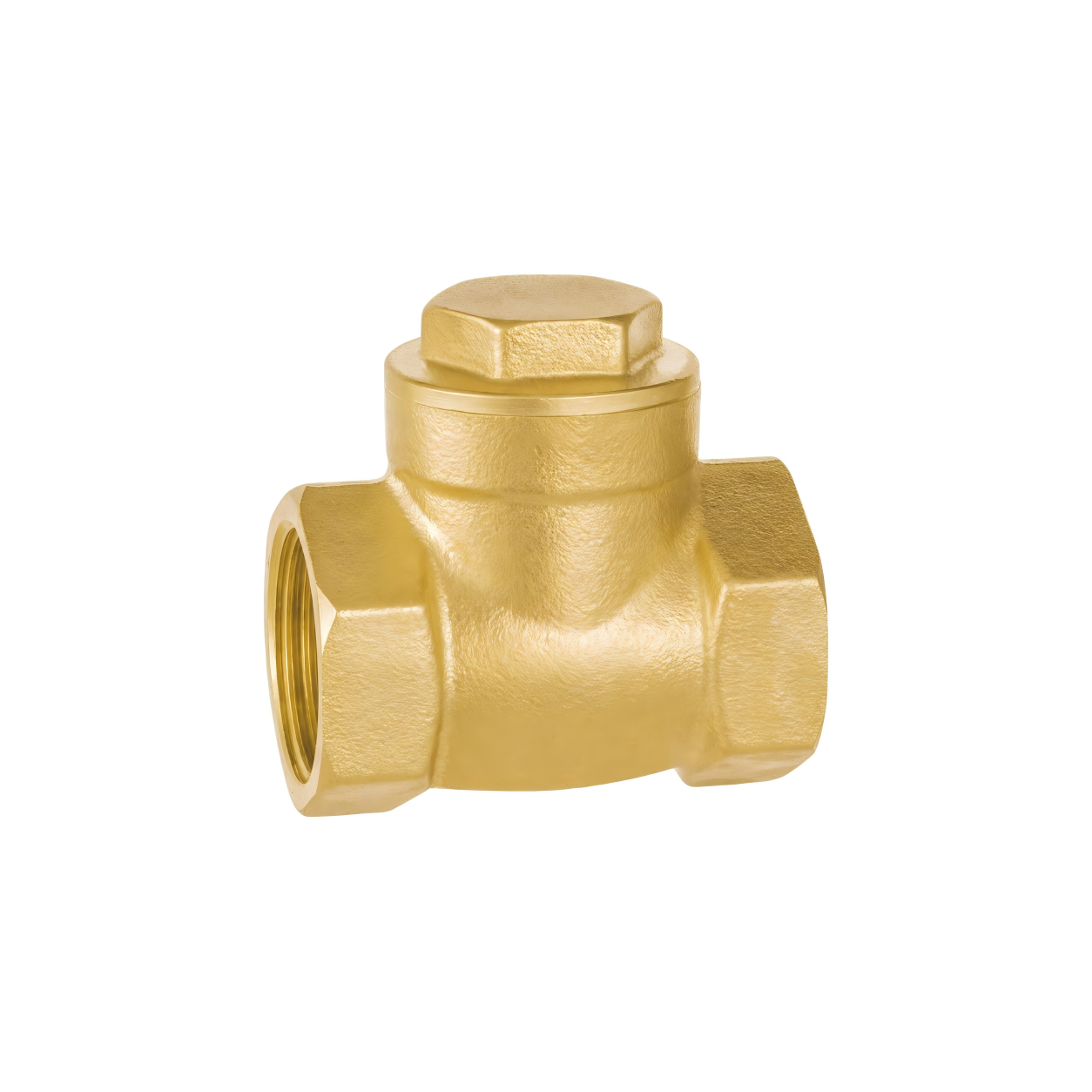
This brass horizontal check valve is a threaded non-return valve used to allow flow in the intended direction while helping prevent reverse flow through the piping system.
The series is available in sizes from 1/2″ to 4″, covering a relatively wide connection range for threaded piping applications.
The supplied catalogue lists two model designations:
H14X-16T and H14W-16T.
Because the catalogue page does not explain the technical difference between the two versions, internal sealing structure and material differences should be confirmed before ordering.
Specification Note:
The catalogue confirms the product type, model numbers and size range, but does not provide the exact thread standard, working pressure, working temperature or complete internal material list on this page. These items should be confirmed for the required order rather than assumed.
How Does a Brass Check Valve Work?
A check valve is designed for one-way flow control.
During normal operation, forward-flow pressure causes the internal closing component to move away from its sealing position.
When forward flow decreases or reverse pressure occurs, the internal mechanism returns toward the closed position and restricts reverse flow.
Fluid enters the valve in the intended flow direction.
Sufficient forward pressure moves the closing component away from the seat according to the valve design.
Fluid passes through the internal flow path toward the outlet.
When flow stops or reverses, the internal closing element returns toward the sealing position.
Important:
The catalogue image does not show enough detail to confirm whether this series uses a swing, lift, spring-loaded or another specific internal check-valve mechanism. That information should be confirmed from the corresponding technical drawing or product specification.
Product Specifications
| Parameter | Specification |
|---|---|
| Product Type | Brass Horizontal Check Valve |
| Catalogue Models | H14X-16T / H14W-16T |
| Body Material | Brass |
| Connection | Female Threaded Ends |
| Size Range | 1/2″–4″ |
| Thread Standard | To Be Confirmed |
| Working Pressure | To Be Confirmed |
| Working Temperature | To Be Confirmed |
| Applicable Medium | To Be Confirmed |
| Internal Structure | To Be Confirmed |
| Internal Component Materials | To Be Confirmed |
Available Sizes
The supplied catalogue lists the following connection sizes:
| Size | Availability |
|---|---|
| 1/2″ | Available |
| 3/4″ | Available |
| 1″ | Available |
| 1-1/4″ | Available |
| 1-1/2″ | Available |
| 2″ | Available |
| 2-1/2″ | Available |
| 3″ | Available |
| 4″ | Available |
Buyer Note:
Nominal valve size alone is not enough to guarantee piping compatibility.
The exact thread standard should also be confirmed before placing an order.
Why Is the Thread Specification Important?
This valve uses female threaded inlet and outlet connections, but the catalogue page does not specify whether the required thread is BSPP, BSPT, NPT or another standard.
This is important because two valves with the same nominal size can still have incompatible threaded connections.
Buyers should therefore confirm:
- Nominal size
- Thread standard
- Female connection requirement
- Mating pipe or fitting
- Destination project’s technical specification
For a detailed explanation of different pipe-thread systems, see our
BSP vs NPT thread differences
.
H14X-16T vs H14W-16T: What Is the Difference?
Both H14X-16T and H14W-16T are listed on the supplied catalogue page.
However, the catalogue excerpt does not provide enough information to confirm the exact difference in internal structure, sealing material or application between the two models.
Do not select only from the model code:
Before using H14X-16T or H14W-16T in a quotation or purchase order, confirm the corresponding internal material and sealing specification from the approved technical data.
What Should Buyers Confirm Before Ordering?
Select the required nominal connection size between 1/2″ and 4″.
Confirm the exact pipe-thread system required by the mating piping or fitting.
Confirm whether H14X-16T or H14W-16T is required and verify the corresponding internal specification.
Confirm the actual system working pressure and required valve rating before selection.
Provide the fluid or gas handled by the piping system so material and sealing suitability can be evaluated.
Provide the minimum and maximum operating temperature for the application.
Quality Control Points for Threaded Brass Check Valves
For threaded check valves, finished product quality should not be evaluated from external appearance alone.
Relevant inspection points may include:
- Valve body condition
- Female thread dimensions
- Thread cleanliness and burr control
- Internal component installation
- Correct flow direction marking where applicable
- Opening and closing function
- Seat leakage testing according to the agreed requirement
- Shell pressure testing according to the agreed requirement
Practical QC Point:
Thread inspection and finished-valve functional testing serve different purposes.
A correctly machined thread does not by itself prove sealing performance, while a pressure test does not replace dimensional control of the threaded connection.
You can also view more
brass check valve options
for different connection configurations.
Frequently Asked Questions
What sizes are available for this brass check valve?
The catalogue lists 1/2″, 3/4″, 1″, 1-1/4″, 1-1/2″, 2″, 2-1/2″, 3″ and 4″ sizes.
What thread standard does this valve use?
The supplied catalogue page confirms female threaded connections but does not identify the exact BSPP, BSPT, NPT or other thread standard. The required thread should therefore be confirmed before ordering.
What is the difference between H14X-16T and H14W-16T?
Both model numbers are listed in the catalogue, but the supplied page does not provide enough technical information to confirm the exact difference. The internal sealing and component specification should be checked against the corresponding product data before selection.
What is the working pressure?
Working pressure is not explicitly provided on the supplied catalogue page and should be confirmed before publication or ordering rather than inferred only from the model number.
Can this valve prevent reverse flow?
A check valve is designed to allow flow in the intended direction and restrict reverse flow. Actual performance depends on the valve design, installation conditions, operating pressure and application.
Can I order a specific BSP or NPT version?
The exact thread options for this specific model should be confirmed before quotation. If you have a drawing, existing sample or mating fitting, provide it so the required connection can be evaluated.
Need a Brass Horizontal Check Valve?
Send us your required size, thread standard, quantity, working medium, pressure and temperature. If you are replacing an existing valve, you can also provide a sample, drawing or mating fitting for specification confirmation.