
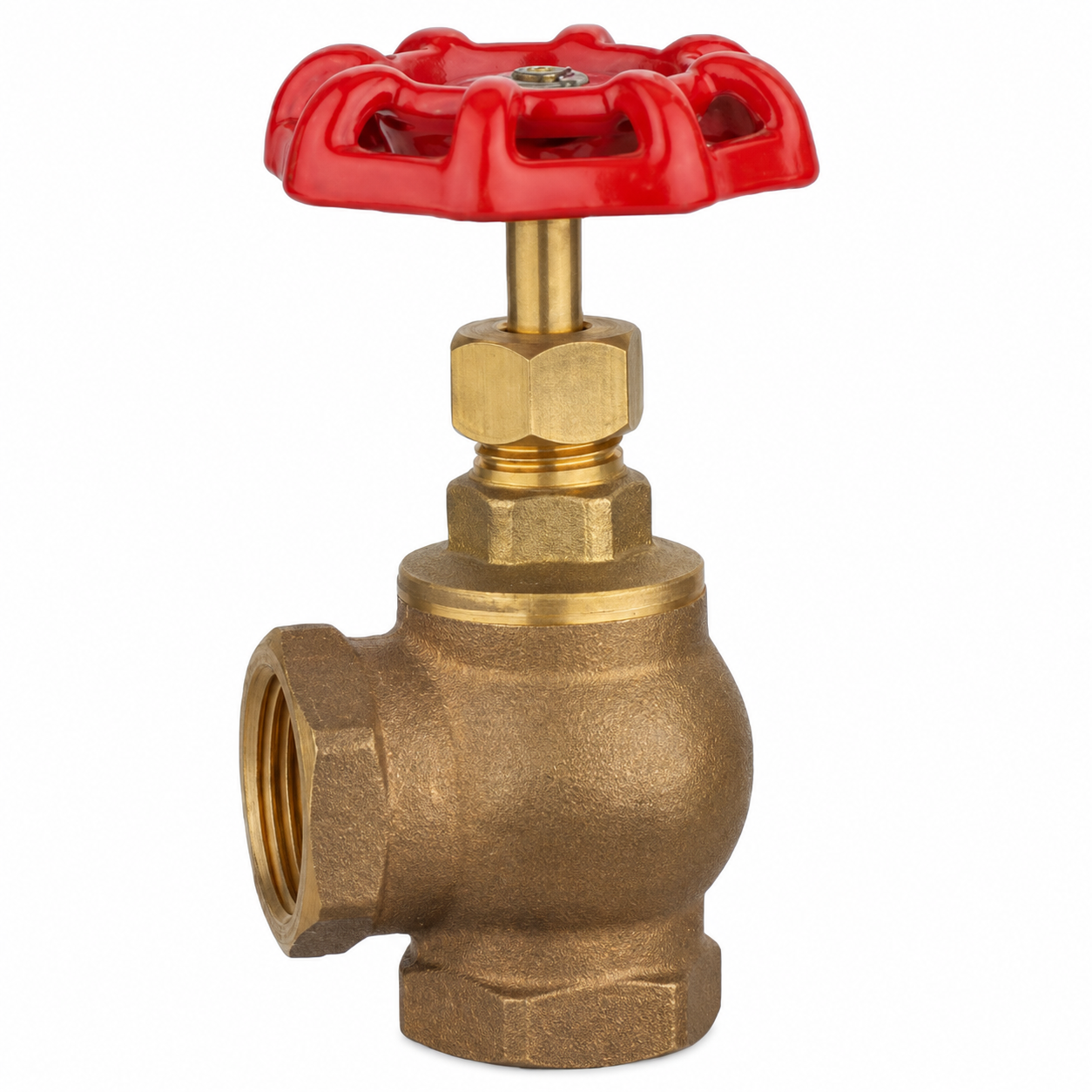
This bronze threaded angle globe valve combines a globe-valve shut-off mechanism with an angle-pattern body.
The rising brass stem and handwheel provide manual control of the valve opening, while the angle-pattern flow path allows the inlet and outlet connections to be arranged at approximately 90 degrees.
The valve is available in 1/2″–2″ with BSP or NPT threaded connections. The catalogue specifies a non-shock working pressure of 2.0 MPa and a working temperature range of -20°C to 120°C.
Design Note:
Unlike a straight-pattern globe valve, an angle globe valve combines flow control with a change in piping direction. Final suitability should still be checked against the actual medium, pressure, temperature and piping layout.
How Does an Angle Globe Valve Work?
A globe valve controls flow by moving an internal plate toward or away from the sealing position.
Turning the handwheel moves the rising stem vertically. This changes the position of the internal plate and therefore changes the available flow passage.
Rotation of the handwheel moves the rising stem through the bonnet assembly.
The rising-stem design provides a visible indication of stem movement as the valve opens or closes.
The internal plate moves toward or away from the sealing position to control the flow passage.
When the plate reaches the sealing position, the flow passage is shut off according to the valve design.
Product Specifications
| Parameter | Specification |
|---|---|
| Product Type | Angle Globe Valve |
| Body Material | Bronze |
| Stem Type | Rising Stem |
| Operation | Handwheel |
| Connection | Threaded |
| Thread Options | BSP / NPT |
| Size Range | 1/2″–2″ |
| Working Pressure | 2.0 MPa Non-Shock |
| Shell Test Pressure | 3.0 MPa Hydrostatic |
| Seat Test Pressure | 2.2 MPa Hydrostatic |
| Air Seat Test Pressure | 0.8 MPa / 8 Bar |
| Working Temperature | -20°C to 120°C |
| Material Requirement | Asbestos Free |
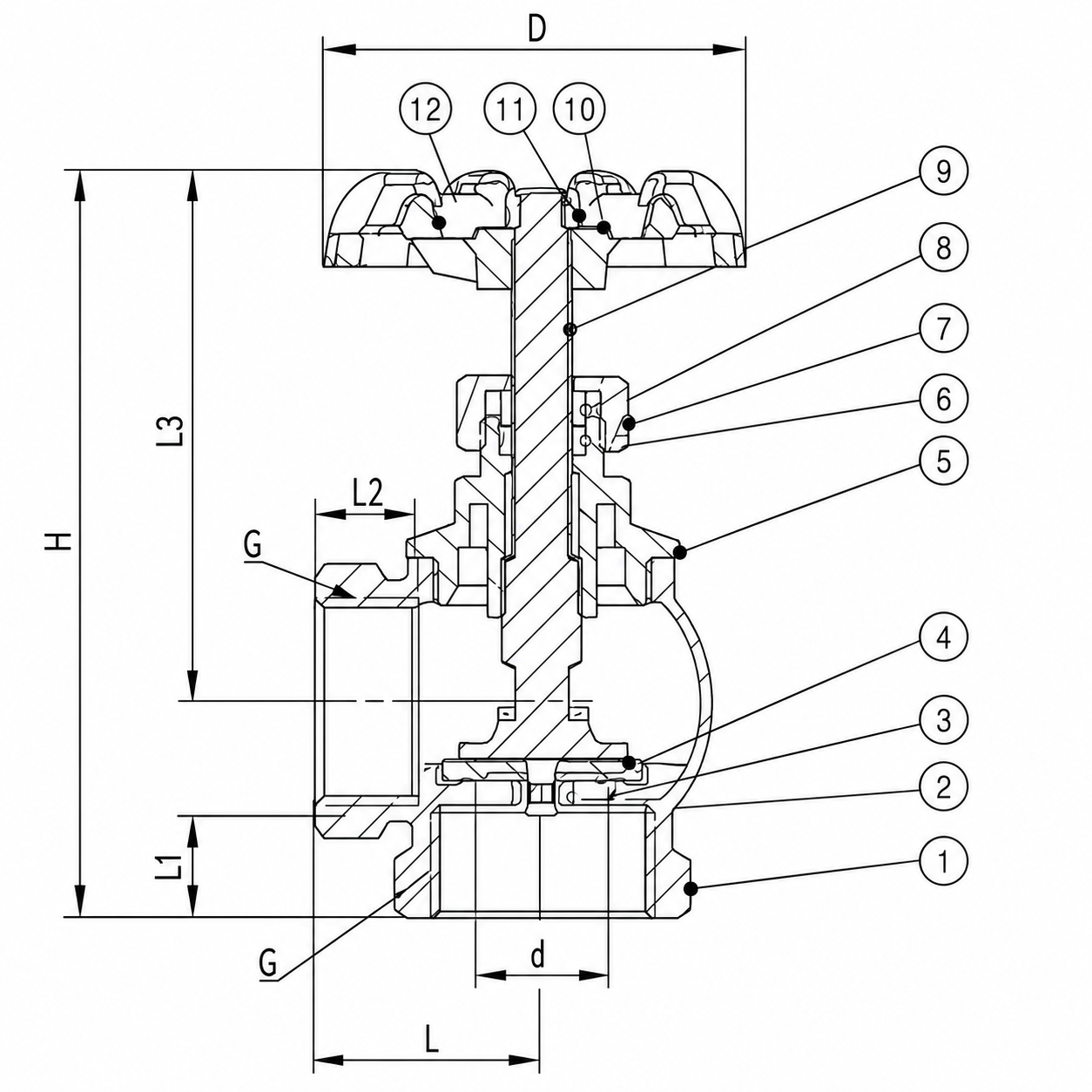
Component Materials
The catalogue specifies the following materials for the main components:
| Component | Quantity | Material |
|---|---|---|
| Handle Wheel | 1 | HT200 |
| Handle Nut | 1 | 304 Stainless Steel |
| Name Plate | 1 | Aluminum |
| Stem | 1 | Brass |
| Brass Ring | 1 | Brass |
| Gland Nut | 1 | Brass |
| Packing | 1 | PTFE |
| Bonnet | 1 | Brass |
| Seal Ring | 1 | EPDM |
| Plate | 1 | Brass |
| Nut | 1 | 304 Stainless Steel |
| Body | 1 | Bronze |
Buyer Note:
The body material alone does not define the complete valve specification. Stem, plate, seal, packing and other internal components should also be confirmed when comparing products from different suppliers.
Dimensions
The catalogue provides the following dimensions for the 3/4″–2″ sizes:
| DN | G | L | L1 | L2 | L3 | d | D | H |
|---|---|---|---|---|---|---|---|---|
| 20 | 3/4″ | 31 | 13 | 13.5 | 78 | Ø17.5 | Ø60 | 106 |
| 25 | 1″ | 34.5 | 16 | 14 | 84.5 | Ø20 | Ø65 | 119.5 |
| 32 | 1-1/4″ | 43 | 20 | 16.5 | 96.5 | Ø27 | Ø72.5 | 139 |
| 40 | 1-1/2″ | 50.5 | 20 | 16 | 105.5 | Ø35 | Ø78 | 152.5 |
| 50 | 2″ | 61.5 | 20 | 17.5 | 107.5 | Ø44 | Ø98 | 166 |
Dimension Note:
The general specification lists a size range of 1/2″–2″, but the supplied dimensional table shows values from 3/4″ to 2″. Please confirm the 1/2″ dimensions before ordering if they are required.
Why Use a Rising Stem?
In a rising-stem design, the stem moves vertically as the handwheel is operated.
This makes stem movement visible and gives operators a simple visual indication of whether the valve is moving toward the open or closed position.
For buyers comparing globe valves, stem type is worth confirming because it affects valve construction, operating space and installation requirements.
What Should Buyers Confirm Before Ordering?
Confirm the required nominal connection size within the 1/2″–2″ range.
Confirm the exact thread standard required for the destination market or piping system.
Provide the actual medium, working pressure and operating temperature.
Check the angle-pattern body and rising-stem height against the available installation space.
Quality Control Points
For a bronze angle globe valve, consistent quality depends on controlling both the machined body and the moving/sealing components.
- Body and bonnet machining dimensions
- BSP or NPT thread dimensions
- Stem alignment and rising-stem movement
- Plate and sealing-position condition
- EPDM seal installation
- PTFE packing condition
- Handwheel opening and closing operation
- Shell and seat testing according to the agreed specification
Practical QC Point:
A globe valve may look correct externally while still having differences in stem movement, internal alignment or sealing condition. Functional inspection should therefore be combined with dimensional and pressure testing.
Frequently Asked Questions
What is a bronze angle globe valve?
It is a globe-type valve with an angle-pattern body, allowing the valve to provide shut-off or flow-control functionality while changing the piping direction through the valve body.
What sizes are available?
The catalogue specifies an overall size range of 1/2″–2″. The supplied dimensional table provides detailed dimensions for 3/4″, 1″, 1-1/4″, 1-1/2″ and 2″.
Are BSP and NPT threads available?
Yes. The catalogue lists BSP and NPT threaded connection options. The required standard should be confirmed before ordering.
What is the working pressure?
The specified non-shock working pressure is 2.0 MPa.
What sealing materials are used?
The catalogue specifies an EPDM seal ring and PTFE packing.
What does rising stem mean?
A rising stem moves vertically as the valve is opened or closed, providing a visible indication of stem movement.
Is the valve asbestos-free?
Yes. The supplied catalogue specification states that this valve is asbestos-free.
Is this valve suitable for my piping system?
Suitability depends on the actual medium, working pressure, temperature, connection standard, installation space and system requirements. These should be confirmed before ordering.
Need a Bronze Angle Globe Valve?
Send us your required size, BSP or NPT thread standard, quantity and application. For replacement or OEM projects, you can also provide a sample, drawing or existing product specification.