
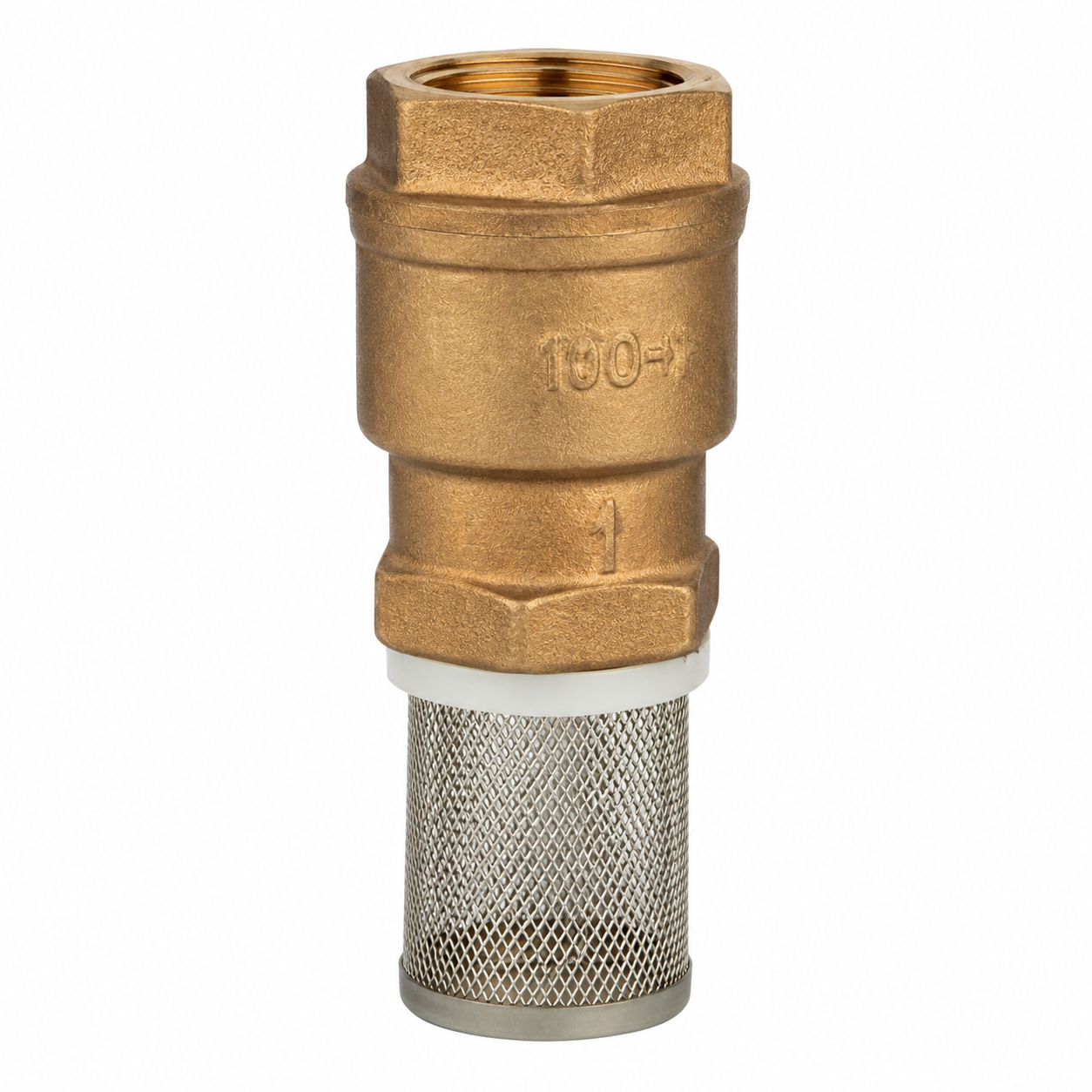
This bronze threaded spring foot valve combines a spring-loaded non-return mechanism with an integrated stainless steel filter mesh.
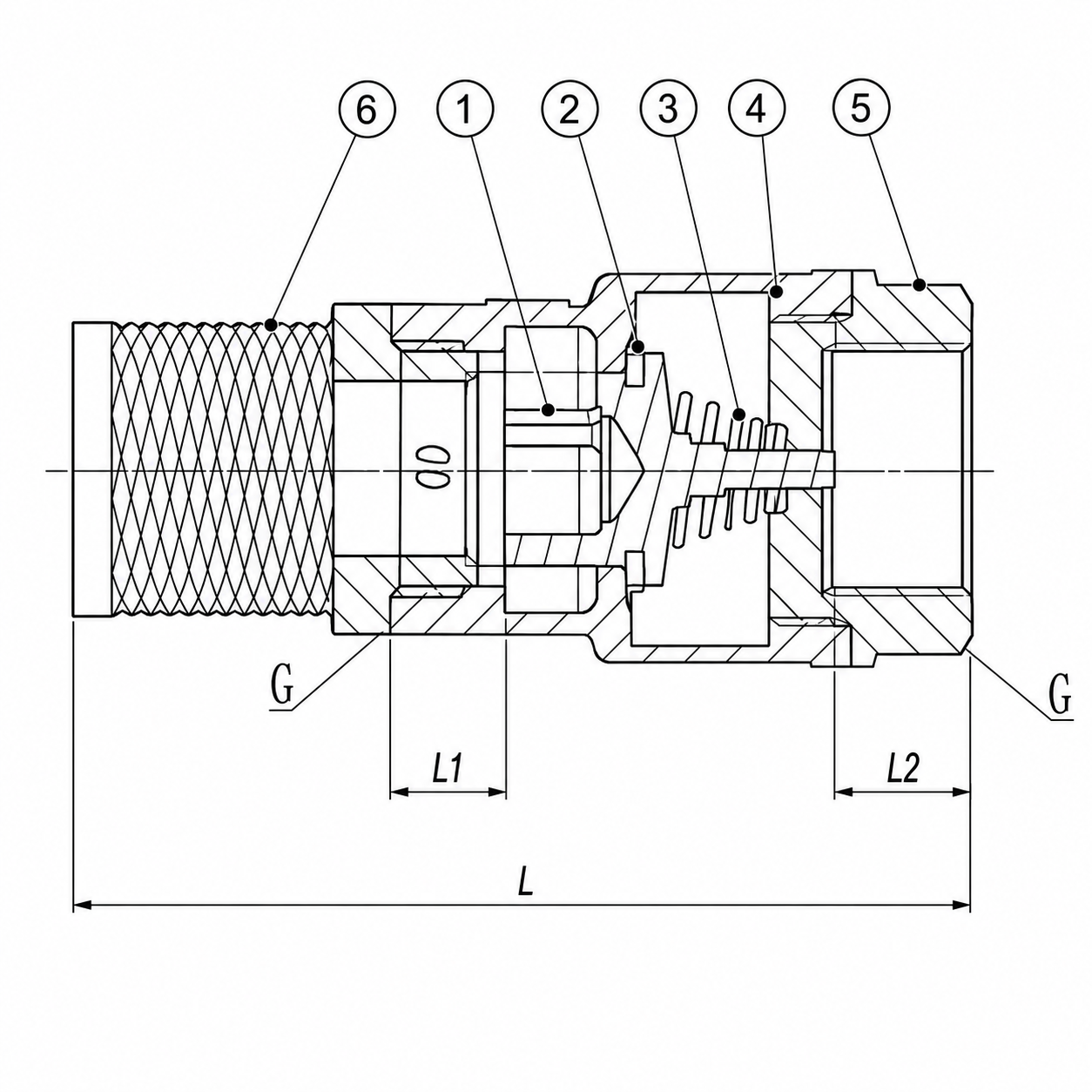
The bronze body, bonnet and disc are combined with a 304 stainless steel spring and filter mesh, while two EPDM seal rings are used in the sealing structure.
Standard sizes range from 1/2″ to 2″, with BSP or NPT threaded connection options. The catalogue specifies a non-shock working pressure of 2.0 MPa and a working temperature range of -20°C to 120°C.
How Does a Spring Foot Valve Work?
A foot valve is a type of non-return valve installed at the inlet side of a suction line. Its purpose is to allow flow in one direction while helping prevent reverse flow when the flow stops.
This model uses a spring-loaded bronze disc together with an integrated filter mesh.
Fluid pressure acts against the disc and spring.
When the pressure is sufficient to overcome the spring force, the disc moves away from the sealing position and allows flow through the valve.
The spring pushes the disc back toward the seat as forward flow decreases.
The closed disc and sealing rings help prevent fluid from flowing backward through the valve.
Important:
A foot valve is a one-way flow-control component. Actual system performance also depends on installation conditions, pump design, piping layout, medium and operating conditions.
Product Specifications
| Parameter | Specification |
|---|---|
| Product Type | Spring Foot Valve |
| Body Material | Bronze |
| Bonnet Material | Bronze |
| Disc Material | Bronze |
| Spring Material | 304 Stainless Steel |
| Filter Mesh Material | 304 Stainless Steel |
| Seal Ring Material | EPDM |
| Connection | Threaded |
| Thread Options | BSP / NPT |
| Size Range | 1/2″–2″ |
| Working Pressure | 2.0 MPa Non-Shock |
| Shell Test Pressure | 3.0 MPa Hydrostatic |
| Seat Test Pressure | 2.2 MPa Hydrostatic |
| Air Seat Test Pressure | 0.8 MPa / 8 Bar |
| Working Temperature | -20°C to 120°C |
Component Materials
The catalogue specifies the following materials for the main valve components:
| Component | Quantity | Material |
|---|---|---|
| Filter Mesh | 1 | 304 Stainless Steel |
| Bonnet | 1 | Bronze |
| Body | 1 | Bronze |
| Spring | 1 | 304 Stainless Steel |
| Seal Ring | 2 | EPDM |
| Disc | 1 | Bronze |
Why the internal components matter:
Foot valve performance depends on more than the bronze body. The disc, spring, sealing rings and filter mesh all affect how the valve opens, closes and controls reverse flow.
Dimensions
| Size | L (mm) | L1 (mm) | L2 (mm) | D | G |
|---|---|---|---|---|---|
| 1/2″ | 84.5 | 11 | 13 | Ø15 | 1/2″ |
| 3/4″ | 92.5 | 12 | 14 | Ø20.3 | 3/4″ |
| 1″ | 111.5 | 14 | 17 | Ø25 | 1″ |
| 1-1/4″ | 125.5 | 17.5 | 18 | Ø32.2 | 1-1/4″ |
| 1-1/2″ | 167 | 18 | 18.5 | Ø40 | 1-1/2″ |
| 2″ | 179 | 19 | 21.5 | Ø50 | 2″ |
Dimension Note:
The table above follows the catalogue drawing. Because BSP and NPT thread options are listed, final thread details should be confirmed according to the connection standard required for the order.
Why Is the Filter Mesh Important?
The filter mesh is positioned at the fluid inlet before the spring-loaded valve mechanism.
Its purpose is to reduce the entry of larger particles and debris that could otherwise reach the internal valve mechanism or downstream suction line.
For this model, the catalogue specifies 304 stainless steel for the filter mesh.
Filtration Note:
The catalogue does not specify a mesh grade or micron rating. This foot valve should therefore not be described as providing a specific filtration accuracy unless that specification is separately confirmed.
What Should Buyers Check Before Ordering?
Confirm the required connection size from 1/2″ to 2″.
Confirm whether the installation requires BSP or NPT threads.
Provide the actual medium, pressure and operating temperature.
Provide the pump or piping application so the product specification can be evaluated before ordering.
Quality Control Points
For a spring-loaded bronze foot valve, quality inspection should consider both the external body and the internal non-return mechanism.
- Thread dimensions and connection condition
- Bronze body and bonnet condition
- Disc movement and spring assembly
- Correct installation of the two EPDM sealing rings
- 304 stainless steel filter mesh condition
- Opening and closing operation
- Pressure and seat testing according to the agreed specification
Frequently Asked Questions
What is a bronze foot valve used for?
A foot valve is installed at the inlet side of a compatible suction line to allow flow in one direction while helping restrict reverse flow when pumping stops.
What sizes are available?
Catalogue sizes are 1/2″, 3/4″, 1″, 1-1/4″, 1-1/2″ and 2″.
Are BSP and NPT threads available?
Yes. The catalogue lists BSP and NPT threaded versions. Confirm the required thread standard before ordering.
What is the working pressure?
The catalogue specifies a non-shock working pressure of 2.0 MPa for the 1/2″–2″ size range.
What material is the filter mesh?
The integrated filter mesh is specified as 304 stainless steel.
What sealing material is used?
Two EPDM sealing rings are specified in the catalogue.
Does the filter mesh have a specified micron rating?
The catalogue does not provide a mesh grade or micron rating. If filtration accuracy is important to your project, it should be confirmed before ordering.
Is this foot valve suitable for my pump system?
Suitability depends on the actual medium, pressure, temperature, connection standard, piping design and pump requirements. These conditions should be reviewed before product selection.
Need a Bronze Spring Foot Valve?
Send us your required size, BSP or NPT thread standard, quantity and application. For replacement or OEM projects, you can also provide an existing sample, drawing or product specification.